
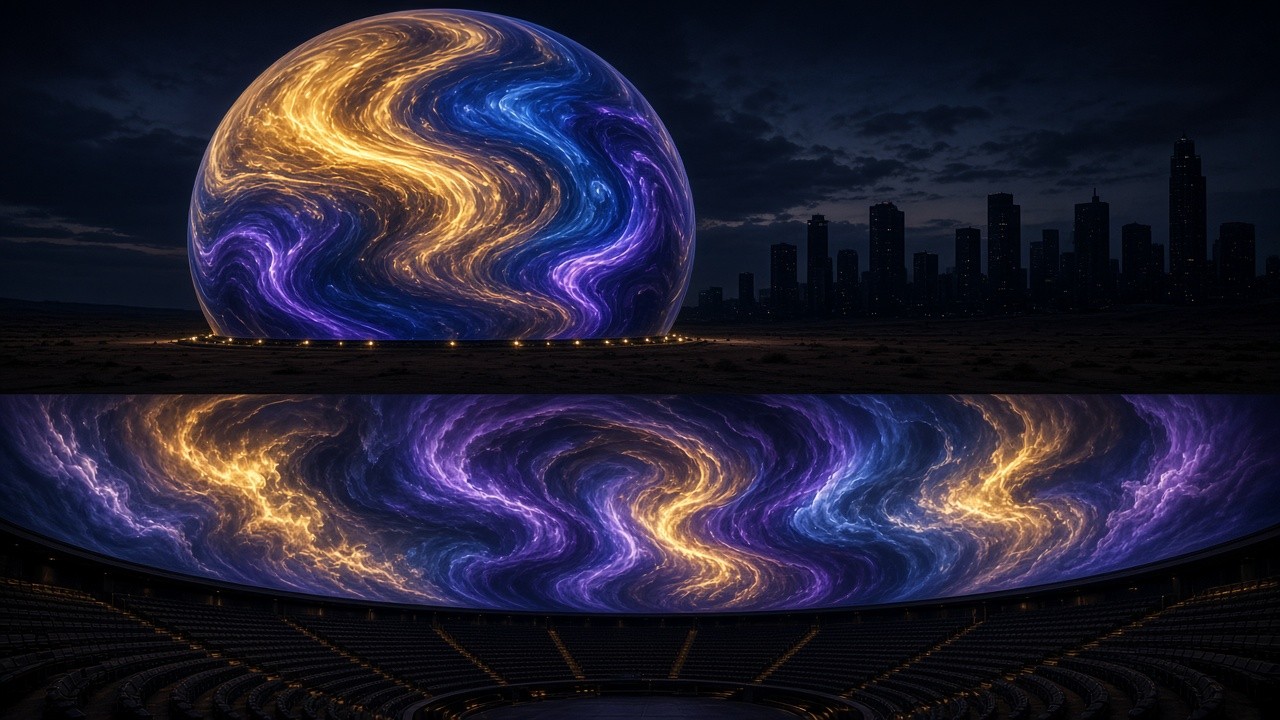
U2 opened it. The Eagles and Dead & Company turned it into a season. The Wizard of Oz walked into the walls. Filings now show the money — and the bill — behind the most enveloping room in entertainment.
A theatre used to mean a room with a stage, a curtain and a promise that you would sit still and look forward. Then Las Vegas opened a vast LED sphere and the forward wall disappeared. Since U2 walked into that room on 29 September 2023, the Sphere has not just booked concerts. It has rewritten what a venue can ask of a story, a film, a residency — and of every traditional theatre that now has to live in its shadow.
A building that behaves like a medium
Sphere Entertainment’s own filings describe the trick in hardware, not hype. The Wizard of Oz at Sphere, which debuted on 28 August 2025, is built for a 160,000-square-foot interior display and for Sphere Immersive Sound’s 167,000 programmable speakers. The company says the show also uses high-velocity wind arrays, atmospheric fog, towering fire bursts and infrasound haptic seats, plus artificial intelligence and visual effects, to put an audience inside the film rather than in front of it. That is not a bigger IMAX. It is a different machine. The old auditorium sold a picture. This one sells weather.
The literary jump is the tell. A century-old story has been remade as a place you enter, the way other book-born worlds have leapt from the page to a park or a screen, from the wider question of how literary and cinematic IP now travels between page, screen and strategy to the wizarding world J.K. Rowling built for a generation. The Sphere is what happens when that leap is a venue, not a studio lot. Even the AI in the filings belongs to a wider fight about who owns the tools that now shape a story.
The residencies that proved the room
U2 opened the Las Vegas Sphere and, the company’s 2025 Form 10-K says, played 40 shows through March 2024. Dead & Company then completed 48 shows across 2024 and 2025. The Eagles began a multi-month residency in September 2024 that the same filing called the venue’s longest, with 58 shows scheduled through April 2026. Other runs have followed. The point is not a diary of every date. It is that the Sphere turned the old one-night stand into a season, the way a stadium tour used to, except the set never has to leave town. The Global Concert has already logged the next wave, from Rush’s 2027 Sphere run to the November 2026 tour calendar and U2’s 2027 European dates. Taylor Swift’s touring era, which we have already treated as a global live-business story, is the other half of the same shift: the artist is now a residency, a route, a month on the calendar.
Traditional theatres still own intimacy, language and a ticket that does not need a desert skyline. What they no longer own is the monopoly on being the most enveloping room in the culture.
The invoice, and the next spheres
None of this was cheap. The Nevada Independent and KTNV have reported the Las Vegas venue’s final construction cost at $2.3 billion. The operating numbers are now catching up, unevenly. In its filing for the quarter ended 30 September 2026, Sphere Entertainment reported total revenue of $274.3 million, up 4 per cent, and Sphere-segment revenue of $198.9 million, up 14 per cent. For the nine months, company revenue was $974.3 million, against $825.8 million a year earlier. The Wizard of Oz at Sphere accounted for 241 performances in the quarter and 670 in the nine months, generating about $469,000 and $583,000 in revenue per show, respectively, the filing says. Event-related revenue also rose, with three additional concert-residency shows in the quarter. The same quarterly report still posted an operating loss of $240.6 million. A hit room and a profitable company are not yet the same sentence.
The company is trying to turn one miracle building into a network. In May 2026, Yas Island was selected as the site for Sphere Abu Dhabi; the Department of Culture and Tourism – Abu Dhabi is funding construction, which filings say is expected to be completed by the end of 2029. In January 2026, Sphere Entertainment, the State of Maryland, Prince George’s County and Peterson Companies announced an intent to develop a Sphere at National Harbor, Maryland. Las Vegas was the proof of concept. The plan is to stop it being a one-off. We have already watched the city around it in US Pulse News’s look at the craze for Las Vegas.
What this means for traditional theatres
It does not mean the playhouse is finished. A 200-seat room can still wreck you with a monologue. Hollywood Movie Times has been tracking the other screen wars — from the AI reckoning inside the film business to IMAX selling a spaceship as a ticket — and those rooms are not trying to be a Sphere. They are trying to stay necessary. The craft of a face in a close-up, the thing a career like Tom Hanks’s was built on, still belongs to a frame, not a haptic seat.
What the Sphere changed is the ceiling. Concerts can now be filmed weather. A classic film can be a walk-in climate. A residency can outlast a Broadway season without moving an inch. Traditional theatres will keep doing the work only they can do. They just no longer get to pretend they are the last word in spectacle. A repertory house can still change a life in two hours, at a fraction of a $2.3 billion construction bill, for an audience that came to hear language rather than to stand inside a storm. The sphere in the desert already said the other part out loud, with the wind turned on: if you are selling wonder at stadium scale, the old rectangle is no longer the only, or the loudest, room in town.