
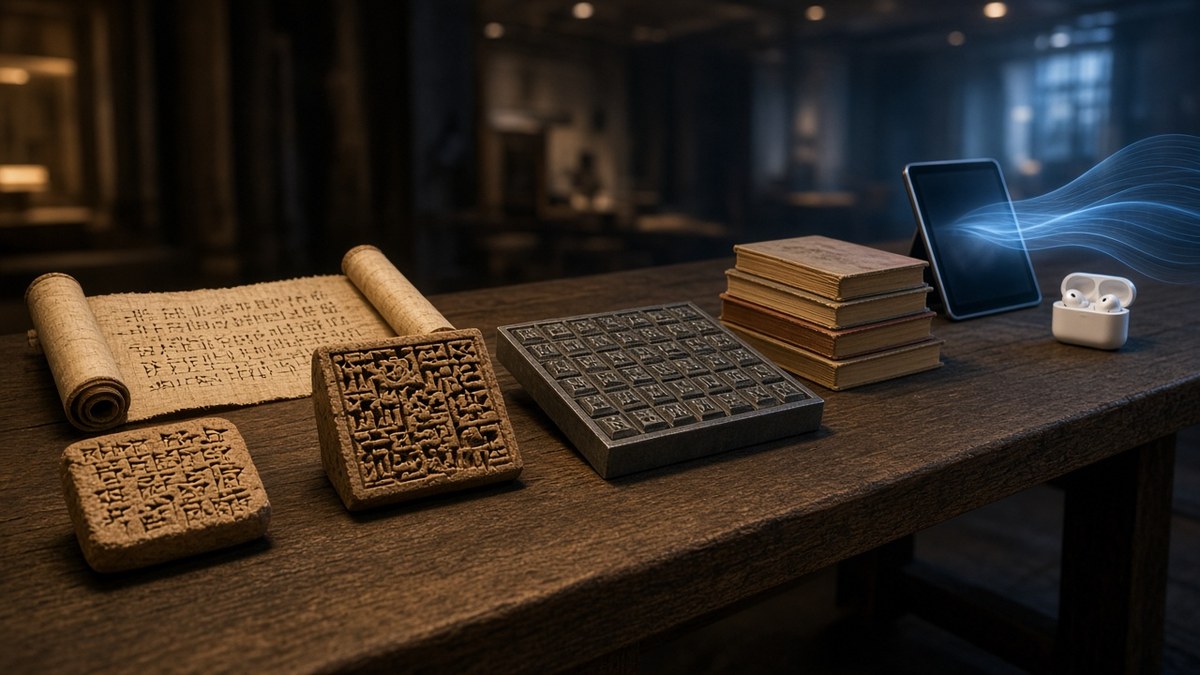
Publishing feels like a modern business of contracts and launch dates, but its story starts with wet clay and a reed. The great publishing revolutions of the last 5,000 years each made words cheaper, faster or more beautiful to share. USA Publication House traces six of them, and ends with the one unfolding right now.
1. Clay Tablets, Uruk, About 3200 BC
In the Sumerian city of Uruk, in modern Iraq, scribes pressed wedge shaped marks into clay to track grain and goods. Cuneiform grew into law, letters and literature, including the Epic of Gilgamesh. The first publishers worked in mud, and some of their tablets have lasted 5,000 years.
2. The Library of Alexandria, 3rd Century BC
Under the Ptolemaic kings of Egypt, the Library of Alexandria set out to collect the knowledge of the known world. Ships arriving in the harbour were reportedly searched for scrolls to copy. It became the model for every great library since.
3. The Diamond Sutra, 868 AD
A woodblock printed copy of the Buddhist Diamond Sutra, found in a cave at Dunhuang in China, carries a date equal to 868 AD. Now held by the British Library, it is the earliest dated printed book known, nearly six centuries before Gutenberg.
4. Gutenberg’s Press, 1450s
In Mainz, Johannes Gutenberg combined movable metal type, oil based ink and a screw press. By 1500, presses across Europe had printed millions of books. Ideas could now spread faster than any ruler could stop them.
5. Publishing Revolutions in Your Pocket: Penguin Paperbacks, 1935
In 1935, Allen Lane launched Penguin Books in London, selling quality paperbacks for sixpence, about the price of a pack of cigarettes, in stores like Woolworths. Great literature became an impulse buy, and the paperback age began.
6. E-Readers and Audiobooks, 2007 Onward
Amazon’s Kindle launched in November 2007 and sold out within hours. Digital books and, later, audiobooks on phones turned commutes into reading time, and audio has become one of publishing’s fastest growing formats.
The Future Angle: The Seventh Revolution
The next of the publishing revolutions is already here: AI narration, instant translation into dozens of languages and stories that adapt to each reader. The constant across 5,000 years is the writer with something to say. Read how the industry is adapting in Audible’s AI audio discovery, revisit seven books that changed the world, and see why AI talent is in demand in what makes an AI polymath.
Visit the future: send us your idea
What will publishing look like in 2076: books that write back, stories in your glasses, libraries on Mars? Send USA Publication House your idea. Send us your idea.
FAQ
What is the oldest printed book?
The oldest dated printed book known is a copy of the Diamond Sutra, a Buddhist text printed from woodblocks and dated to 868 AD. It was found in a sealed cave at Dunhuang in northwest China and is now held by the British Library in London, where it is a star of the collection.
When did paperbacks become popular?
Paperbacks existed earlier, but they took off after Allen Lane launched Penguin Books in London in 1935. Penguin sold well designed paperback editions of quality books for sixpence in everyday shops such as Woolworths, proving that serious literature could reach a mass market at low prices.
When was the Kindle launched?
Amazon launched the first Kindle e-reader in November 2007. The first stock sold out within hours. The Kindle, along with other e-readers and reading apps, made digital books mainstream and helped prepare the market for the later boom in audiobooks streamed on phones and smart speakers.
Keep reading
- 7 Books That Changed the World, From the Gutenberg Bible to Harry Potter, in 2026
- 6 Leaps in the History of Invention Across 10,000 Years, Up to 2026
- Book Deals This Week: Moshfegh, Akbar and Cathy Park Hong Spark a 48-Hour Pre-Empt Frenzy in British Publishing
Sources named in text: British Museum; British Library; Gutenberg Museum, Mainz; Penguin Random House archives; Amazon.