
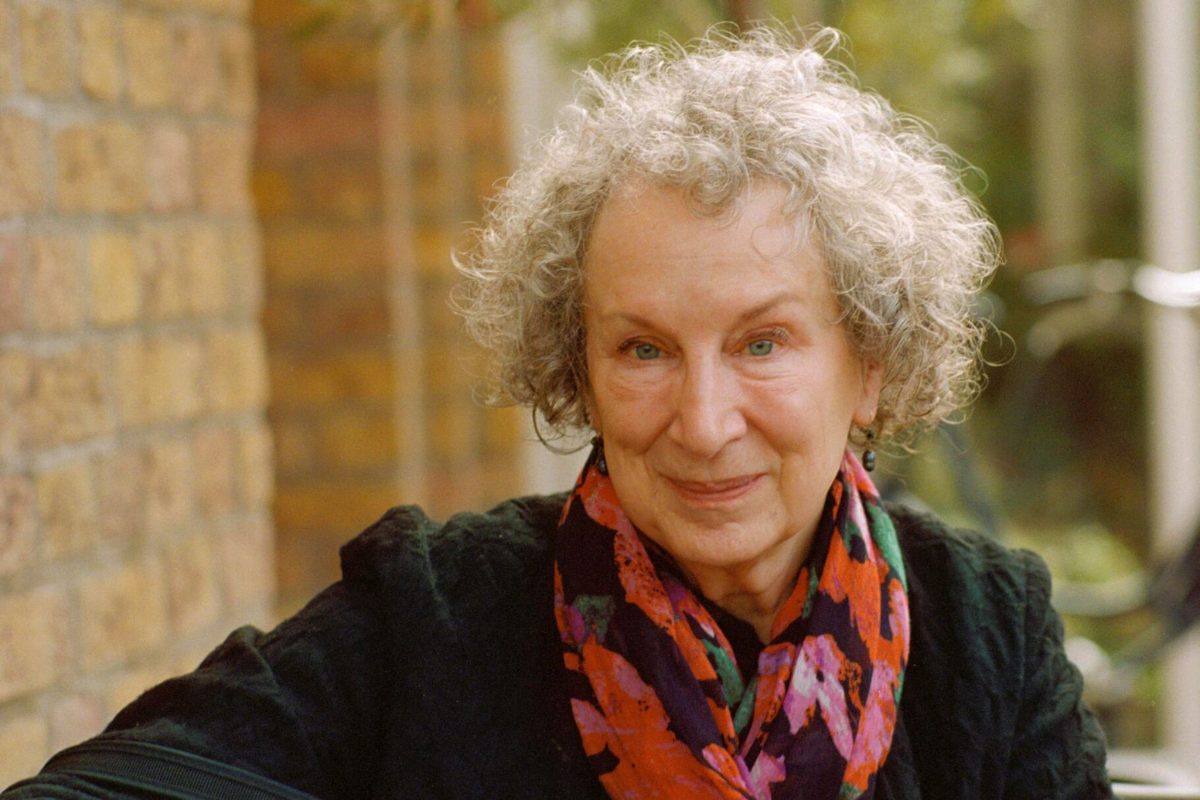
[Reading by Margaret Atwood]
“Wild things are smarter than tame ones. Wild things are elusive, clever, and always looking out for themselves. I divide people I know into the tame and the wild. My mother: wild. My father and brother: wild too. Mr. Benerji: wild in a nervous way. Carol: tame; Grace: tame, though with flickers of wildness. Cordelia—wild, pure and simple.”
Studs Terkel: That was Margaret Atwood, reading from her novel Cat’s Eye, published by Doubleday. It’s a striking and revealing passage. You may recall her earlier works—The Handmaid’s Tale, unsettling in its vision of a possible future, as well as Life Before Man and her poetry. Always sharp, always provocative.
Margaret, let’s talk about Cat’s Eye. At its center is Elaine Risley, a painter reflecting on her childhood in Toronto. That passage you read describes her way of seeing people—wild or tame. Cordelia, for example, is one of the wild.
Margaret Atwood: Yes, Cordelia is Elaine’s best-friend-worst-enemy at nine and ten years old. At that age Cordelia dominates her, but when they become teenagers, the balance shifts. Elaine gains control, while Cordelia begins to unravel.
Terkel: That shift—power changing hands—that’s central to the book. Elaine, the put-upon girl, endures torment from Cordelia and her friends. Yet eventually, the energy shifts.
Atwood: Exactly. Childhood politics, especially among little girls, can be brutal—but subtle. The book explores that.
Terkel: You’ve written about time, memory, and the haunting nature of childhood. You even quote Stephen Hawking: “Why do we remember the past and not the future?” In the novel you move constantly between past and present.
Atwood: The childhood scenes take place in the 1940s, just after the war. Schools were strict, with boys’ and girls’ entrances, rows of desks, rulers, and straps for punishment. Childhood then was more secretive. Kids had an unspoken code: don’t tell. Elaine, new to this world of girls, enters into their hidden politics. Unlike boys, who fought openly and physically, girls fought verbally, with shifting alliances. It was like a miniature Renaissance court.
Terkel: And those court politics were everywhere—not just in Canada. But in Cat’s Eye, Elaine discovers with horror that one adult—Grace’s mother, Mrs. Smeath—actually approves of the cruelty she suffers.
Atwood: Yes, Mrs. Smeath is judgmental in a harsh Christian way, believing people “deserve” their suffering. For Elaine, realizing an adult condones her torment is devastating.
Terkel: Elaine becomes a painter, and years later, those childhood figures reappear in her art. She paints Mrs. Smeath in disturbing, almost vengeful ways.
Atwood: Exactly. As a child she was powerless, but as an artist she can reshape Mrs. Smeath however she chooses—naked, emerging from a gift box. It’s a form of revenge, but also control.
Terkel: Yet she’s still haunted, especially by Cordelia, who vanishes from her life. Returning to Toronto, Elaine sees her everywhere—in shadows, reflections, glimpses.
Atwood: The novel is a ghost story in that sense. Cordelia is Elaine’s ghost. Though gone, she lingers in every corner of Elaine’s memory.
Terkel: You touched something deep here. When this book came out, people phoned a Toronto radio program and said, “Yes, I had a Cordelia too.” Everyone seemed to remember the one child who tormented them.
Atwood: That’s true. People described the street, the weather, the clothes. The memories were vivid, and many still carried anger decades later. We all have a Cordelia, it seems.
Terkel: You also sketch the families—the different social classes and pretensions. Cordelia’s family, with its Shakespearean names, is the most pretentious. Grace’s family, rigidly religious, is at the other end. Elaine’s own family is unconventional: her father an entomologist, her brother eventually a physicist.
Atwood: Yes, her father studied insects and warned about environmental damage long before it was fashionable. He seemed eccentric then, but time has proven him right. Elaine’s brother pursued cosmology. That contrast—science and art—shapes her world.
Terkel: Then there’s Toronto itself, another character in the novel. You describe the old dull Toronto—“Hogtown”—and the new glitzy one. Elaine’s retrospective exhibition happens in this changed city.
Atwood: Toronto shifted enormously in forty years. Once mocked as boring, it became cosmopolitan, almost “the Paris of the northeast.” That transformation mirrors Elaine’s own shifting sense of identity.
Terkel: At her gallery show, she’s interviewed by Andrea, a young critic from a different generation. That exchange is sharp and funny—Andrea asking about “fame” and the “’70s generation,” and Elaine replying, “Fame is Elizabeth Taylor’s cleavage. This is just a media pimple.”
Atwood: Elaine is prickly, skeptical of being labeled. Her formative years were the 1940s, not the 1970s. That’s why she emphasizes long attention spans, making do, remembering the war. Andrea can’t imagine that.
Terkel: So Cat’s Eye is about memory, art, childhood cruelty, power, the haunting past, and the shifting city. And at the heart, a marble—the Cat’s Eye—that Elaine saves as a talisman, forgotten for years, then rediscovered.
Atwood: Yes. That small marble embodies protection and memory. For Elaine, it’s both a comfort and a trigger.
Terkel: A ghost story, a tale of survival, and the making of an artist. That’s Cat’s Eye.