
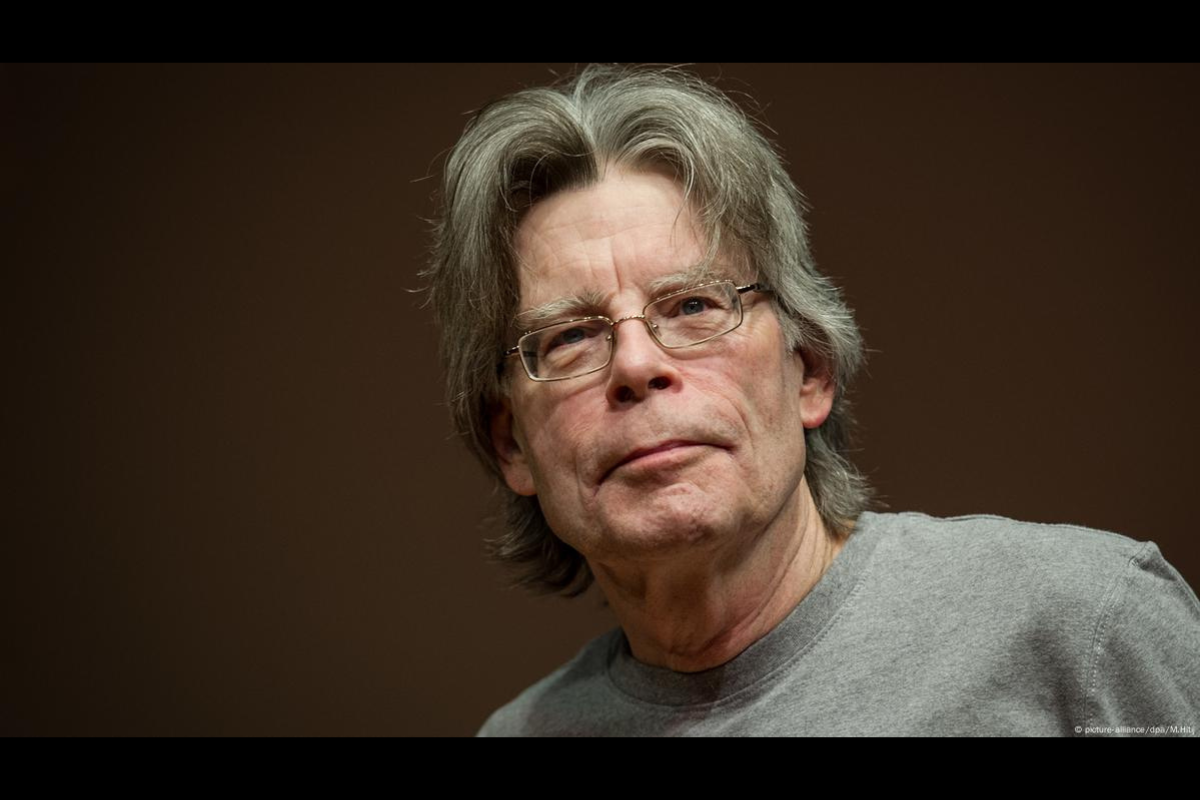
Stephen King is a man of many parts: a rock-and-roll guitarist, a surprisingly good Richard Nixon impersonator, and one of America’s most relentless storytellers. While critics have often debated his literary merits, his readers have never wavered. For King, the story is all that matters, and he has spent a lifetime thinking deeply about what it means to be a working writer.
We met at Harvard University, where he was greeted with thunderous applause—a testament to his rare celebrity status in the literary world. Yet, despite the accolades, including a National Medal of Arts awarded the day after our conversation, King remains, in his own words, a “proletarian novelist.”
On Success and the Spectacle of Fame
Angela S. Allan: Your novel Finders Keepers, much like Misery, deals with authorial ownership. Has your own massive success changed your relationship with your work?
Stephen King: In a general way, I’m aware I’ve become somebody who’s well-known, which is unusual for writers. We’re supposed to be secret agents, recording things unnoticed. Now, what I see is warped by how people see me. Coming in tonight, there were people clustered outside the hotel with books. They’ll say it’s for their grandmother, but it’s really for eBay. You associate that with movie stars, not writers. That changes the day-to-day life.
But when I sit down to write, all that falls away. I’m not thinking about cultural implications or genre. That only happens in the first draft. When you come back to it, you see what’s important—where the lightning struck. Those are almost always the cultural and thematic things, and I just try to highlight them.
On Medium and the “Projector in His Head”
Allan: You’ve constantly experimented with media, from ebooks to audiobooks to television. How does the medium shape the story?
King: A lot of that was just new technology popping up. There’s an urge to experiment, to try a new flavor. The nice thing about financial success is that you can try new things.
But movies and TV formed me. My first editor said I had a “projector in my head.” The reason so many of my things have been bought for movies is that the situations are simple and the visuals are extreme. I see things visually. That was reinforced in college with poetry—the power of the image. Don’t tell me someone is sad; show me.
The reason some adaptations fail is that filmmakers get entranced by the visual hook and miss the novelistic heart: character, theme, narrative arc. I gravitate toward miniseries and episodic TV—Breaking Bad, The Sopranos—because they have that texture and depth. They’re superior to movies.
On the “Tar Baby” of Genre
Allan: How do you understand your relationship to genre?
King: It’s a troublesome question. I don’t think of myself as a genre writer, but I’ve never objected to the label. It’s a fight you can’t win. Genre was created by bookstores so casual readers could say, “I want to read romances,” and find them in one section. But you won’t find Rebecca or One Hundred Years of Solitude there, and they have genre elements.
The only time I hesitated was with Mr. Mercedes. I thought, “This is a detective novel, this isn’t what you do.” Then I thought, “Are you really not going to write something you want to because it’s a different genre?” So I wrote it anyway. Genre is like kids who say, “I can’t eat this food because it’s touching this other thing.”
In my formative years, I learned about mythic archetypes. That’s what I got interested in. It sounds highfalutin, but I wanted to touch all of those things.
On Writing as Labor
Allan: You’ve written about novelist productivity. Is writing a form of labor for you?
King: It’s a great job because I can only work four hours a day. You reach a point of diminishing returns. When I was younger, I’d work on something new in the morning and something in revision at night. It was never about money; the ideas were all screaming to get out.
I’ve got two sons who are novelists. Joe [Hill] is the same way I was—popping corn. Owen is more laid back. Every writer is different.
On Politics and the Page
Allan: You’re outspoken on issues like gun control. Do your novels make political statements?
King: I’ve been left of center most of my life. My wife will tell you I voted for Nixon in ’68 because he said he had a plan to end the war. Tabby says, “And Steve believed him!” Well, I did. Vietnam radicalized me.
What makes me crazy now is the double standard, especially from people who profess to be Christians. They talk about the national debt their grandchildren will inherit, but none of them talk about the environment, about their grandchildren wearing gas masks.
When I write fiction, everything proceeds from character. I try to write from both points of view. But in nonfiction, the important thing is to not be afraid of the trolls. I want to say what’s in my mind. The gun control thing is like tilting at windmills, but you have to be counted.
On Critics, Legacy, and Being “Proletarian”
Allan: You’re receiving the National Medal of Arts. How do you view the evolution of your critical reception?
King: When I came on the scene, I was seen as a pulp writer. I never complained. I kept my head down and did my work. With literary criticism, if everybody is saying the same negative thing, you’re probably doing something wrong. But usually, they’re all saying something different.
A lot of the old-school critics who thought I was a hack have died. The people writing criticism today grew up with my work. They’re more open-minded.
The thing that used to drive me crazy about critics like Harold Bloom is that they had no understanding of American culture. It was as if literary evolution stopped with Sherwood Anderson. They totally overlooked the novelists of the people. Steinbeck doesn’t get the credit he deserves. Nobody talks about Theodore Dreiser unless to say he was a shitty prose stylist. But Sister Carrie and An American Tragedy are huge landmarks.
That’s what I am: a proletarian novelist. I’m blue-collar. I don’t get fancy restaurants or clothes. I can appreciate Philip Roth and Bernard Malamud—incredible writers. But that’s not all there is. Harold Bloom has no real basis to stand on because he doesn’t seem to know Jim Thompson or Ross Macdonald.
Anyway. Bingo. I’m glad to get the award. They’ll squawk about it, but that’s okay. It adds to the discussion.